
Gold or Silver Jewelry for Your Skin Tone: Which Suits You?
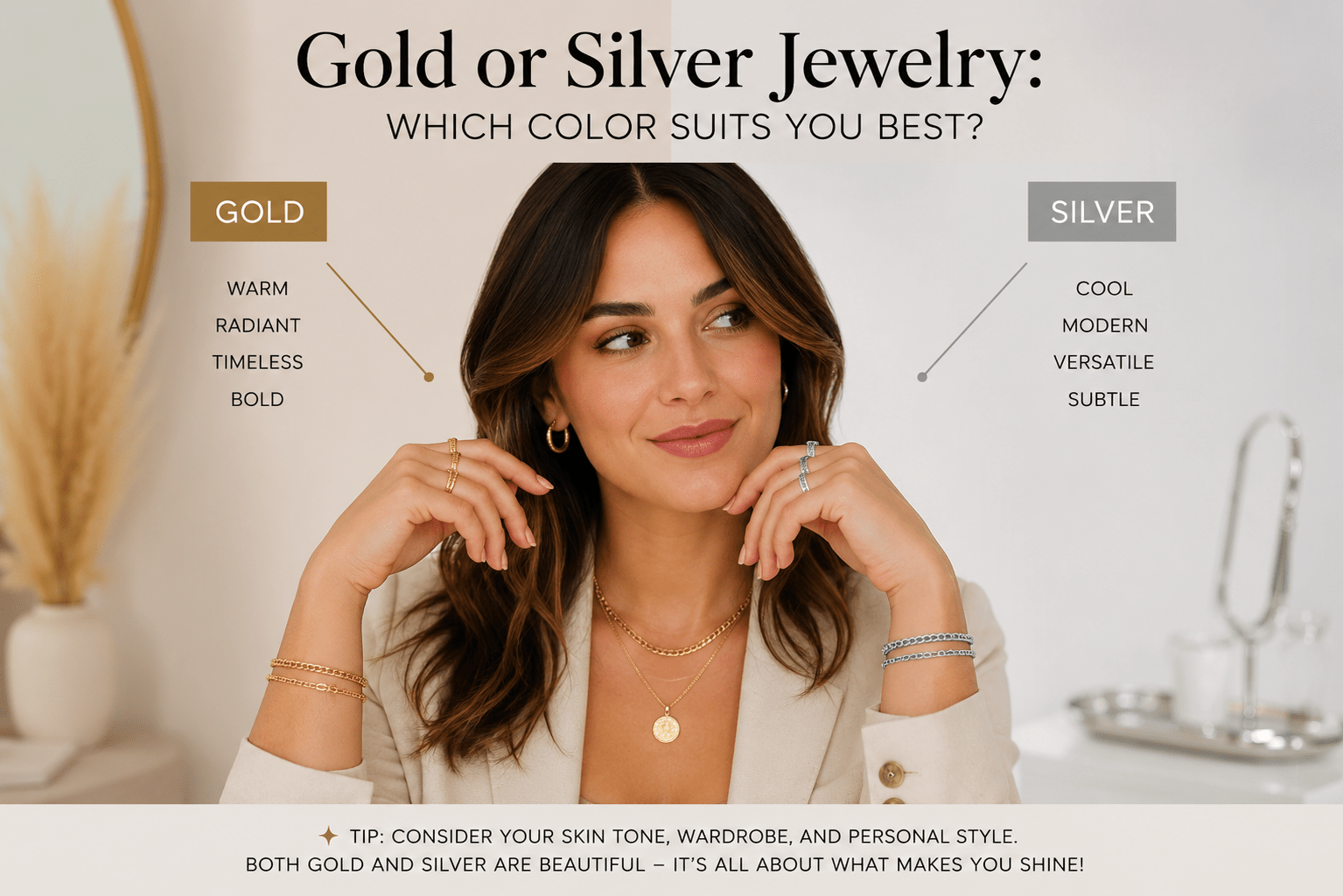
Quick answer: Choosing gold or silver jewelry for your skin tone starts with a side-by-side comparison. Gold often creates a warmer, richer effect, while silver tends to look crisp and cool. Undertone can help, but it is not a rule. Compare both colors near your face in natural light and notice which makes your skin look more even and your eyes more defined. Neutral undertones may suit both, and personal style can matter just as much.
Choosing between gold or silver jewelry is less about a strict beauty rule and more about finding the color that feels harmonious with your features and wardrobe. This guide shows you how to compare both colors and when mixing metals may be the better choice.
Gold or Silver Jewelry for Your Skin Tone: Start With Undertone
Your skin tone is the visible depth of your complexion. Your undertone is the subtle warm, cool, or balanced cast beneath it. Fair skin does not automatically mean silver, and deeper skin does not automatically mean gold.
- Warm undertones: Gold often echoes peach, golden, or yellow warmth and can create a blended, luminous effect.
- Cool undertones: Silver often complements pink, rosy, red, or bluish tones and can look clean and bright.
- Neutral undertones: Both colors may work well, with the better choice depending on the outfit, finish, and mood.
Use these as starting points, not restrictions. Olive and muted undertones can be difficult to classify, so a direct comparison is often more useful than vein color.
Use This 3-Step Gold or Silver Jewelry Test
- Choose similar pieces. Compare two items of similar size and shine, such as the same necklace or ring in gold and silver. A delicate silver chain and a large gold statement piece will not provide a fair comparison.
- Test near your face. Stand in indirect daylight, wear a neutral top, and hold each piece near your jawline or collarbone. Look for the color that makes your complexion appear even rather than dull, gray, overly yellow, or overly red.
- Take two photos. Keep the lighting, clothing, makeup, and camera position the same. The better option is often easier to identify in photographs than in a mirror.


Gold vs. Silver Jewelry Decision Guide
| What you notice | Try first | Why |
|---|---|---|
| Your complexion looks peachy, golden, or warm | Gold | It may reinforce the warmth already present. |
| Your complexion looks rosy, pink, or cool | Silver | It may create a cleaner, brighter contrast. |
| Both colors look balanced | Either or mixed metals | Your wardrobe and preferred style can decide. |
| Neither color looks quite right | Try softer finishes | Brushed, muted, or less reflective tones may feel more harmonious. |
Look Beyond Skin Tone
Your wardrobe: Gold often feels natural with cream, camel, olive, rust, and warm neutrals. Silver can sharpen black, white, gray, navy, denim, and cool jewel tones. These are directions, not rules.
Your preferred effect: Gold tends to read warm and rich. Silver often feels crisp and modern. The effect you want may matter more than an undertone label.
The material beneath the color: “Gold” and “silver” can describe a color option rather than the base metal. Check each product page for the actual construction. The guide to 925 silver versus stainless steel jewelry explains why two similar-looking pieces can wear differently.
Can You Wear Gold and Silver Jewelry Together?
Yes. A mixed-metal look feels intentional when one color leads and the second is repeated. For example, wear mostly gold necklaces with a silver ring and bracelet, or use one two-tone piece to connect the combination.
For an everyday rotation, choose one dominant color for your core pieces and add the other gradually. The everyday jewelry capsule guide can help organize the pieces you wear most.
Compare Both Colors in Real Pieces
The easiest comparison uses the same design in both finishes. The Colette Heart Station Necklace is offered in gold and silver color options, making it useful for a near-the-face test. The Celine Channel-Set Eternity Ring lets you compare the colors on the hand, while the Cecilia Heart Crystal Station Bracelet offers the same choice at the wrist.
Placement matters. A color that feels striking in a ring may create a different effect when worn near your face.
Frequently Asked Questions
How do I know whether gold or silver jewelry looks better on me?
Compare similar pieces in indirect daylight while wearing a neutral top. Hold each color near your face and photograph both under the same conditions. Choose the one that makes your complexion look more even and your features more defined. If both look balanced, you may have neutral coloring or simply suit both metals.
Does the vein test accurately determine my best jewelry color?
The vein test can offer a clue, but lighting, skin depth, and olive or muted undertones can make vein color difficult to interpret. A direct side-by-side comparison is more practical because it measures the visual result you actually care about, how the jewelry looks with your face, clothing, and personal style.
Can neutral undertones wear both gold and silver jewelry?
Usually, yes. Neutral undertones often have enough balance to wear both colors comfortably. You can choose gold for warmth, silver for a cooler effect, or mix both. The scale, shine, texture, and clothing colors around the jewelry may make a bigger difference than the metal color itself.
Should my earrings, necklace, rings, and bracelet all match?
They do not need to match exactly. A coordinated look can use one dominant color with a smaller accent in the other. Repeating the accent color in two places, such as silver earrings and a silver ring with mostly gold jewelry, helps the combination look deliberate rather than accidental.
Choose the Color You Will Actually Wear
Your best jewelry color is the one that flatters you and fits naturally into your wardrobe. Start with undertone, confirm it with a controlled side-by-side test, and let personal preference break the tie. Explore the Everyday Elegance collection to compare refined gold and silver options across necklaces, earrings, and bracelets.