
Article: Stackable Rings 101: How to Mix Metals, Sizes, and Textures
Stackable Rings 101: How to Mix Metals, Sizes, and Textures
You bought three rings you loved individually, put them on together, and somehow the combination looks more cluttered than intentional. Stacking rings is one of the easiest ways to make a simple outfit feel more finished, but like most layering, it works best with a little structure behind it.
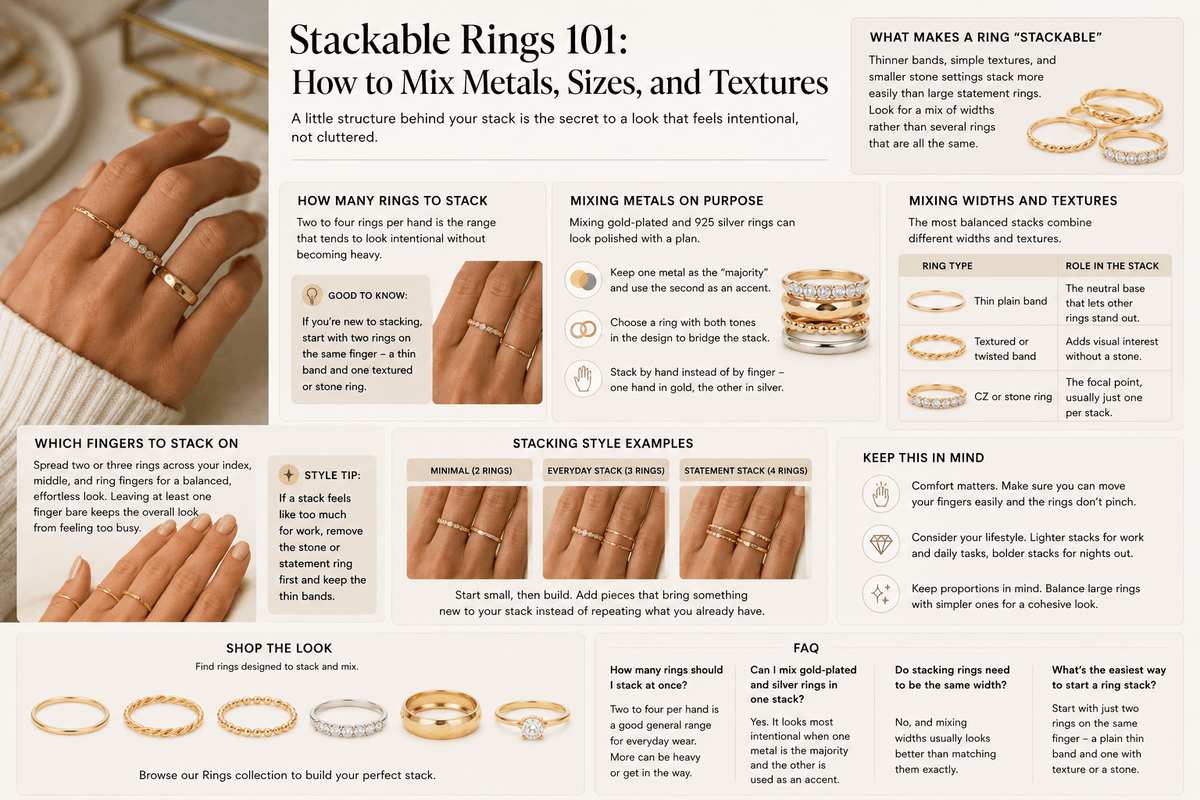
What Makes a Ring "Stackable"
Technically, any ring can be stacked, but some styles work more naturally than others. Thinner bands, simple textured rings, and smaller stone settings tend to stack more easily than large statement rings, which usually work better worn alone or as the single focal point of a stack. If you're buying rings specifically to stack, look for a mix of widths rather than several rings that are all the same size and shape.
How Many Rings to Stack
Two to four rings per hand is the range that tends to look intentional without becoming heavy or hard to move your hand in. Two rings on one finger, or several rings spread across two or three fingers, both work, it comes down to whether you prefer a concentrated stack or a more spread-out look across your hand.
Good to know: If you're new to stacking, start with two rings on the same finger, a thin band and one textured or stone ring. It's the easiest combination to get right before adding more.
Mixing Metals on Purpose
Mixing gold-plated and 925 silver rings in the same stack can look polished, but it works best with a plan rather than random pairing. A few approaches that tend to work:
- Keep one metal as the "majority" and use the second as an accent, like three gold-plated rings and one silver
- Choose a ring with both tones in the design to act as a bridge between an all-gold and all-silver stack
- Stack by hand instead of by finger, one hand in gold-plated pieces, the other in silver, if you want to keep each hand cohesive
Mixing Widths and Textures
A stack made entirely of identical thin bands can look flat, while one made entirely of thick statement rings can feel heavy. The most balanced stacks usually combine:
|
Ring Type |
Role in the Stack |
|
The neutral base that lets other rings stand out |
|
|
Adds visual interest without a stone |
|
|
The focal point, usually just one per stack |
Which Fingers to Stack On
There's no rule that says stacking has to happen on one finger. Spreading two or three rings across your index, middle, and ring fingers on one hand can look just as put-together as piling several on a single finger, and it's often more comfortable for everyday tasks like typing or cooking. If you wear a lot of rings, leaving at least one finger bare tends to keep the overall look from feeling too busy.
Style Tip: If a stack feels like too much for work, remove the stone or statement ring first and keep the thin bands. You'll still get a layered look without it feeling like too much for a professional setting.
Rings are just one piece of a bigger everyday rotation, our guide to building an everyday capsule collection covers how rings fit alongside earrings and necklaces. And if you like the idea of layering pieces beyond your hands, How to Layer Necklaces Without Looking Messy applies many of the same mixing principles to necklaces.
Shop the Look
If you're building a stack from scratch, start with one thin band like the Lonnie Gold Crystal Thin Band Ring and one ring with texture or a CZ stone, like the Adriana Crystal Geometric Ring. Those two pieces alone create a finished look, and you can build out from there as you find pieces that fit your stack. Browse our Rings collection to find pieces sized for stacking.
FAQ
How many rings should I stack at once?
Two to four per hand is a good general range for everyday wear. More than that can start to feel heavy or get in the way of daily tasks.
Can I mix gold-plated and silver rings in one stack?
Yes. It looks most intentional when one metal is the majority and the other is used as an accent, or when one ring in the stack combines both tones.
Do stacking rings need to be the same width?
No, and mixing widths usually looks better than matching them exactly. A thin band paired with a slightly wider textured or stone ring creates more visual interest.
What's the easiest way to start a ring stack if I've never done it before?
Start with just two rings on the same finger, a plain thin band and one ring with texture or a stone. Once that feels comfortable, add a third piece.
Stacking rings comes down to variety, in width, texture, and sometimes metal, rather than matching every piece exactly. Start small with two rings that contrast each other, and build your stack as you find pieces that add something new instead of repeating what you already have. Explore La Vie en Rose's Rings collection to start yours.